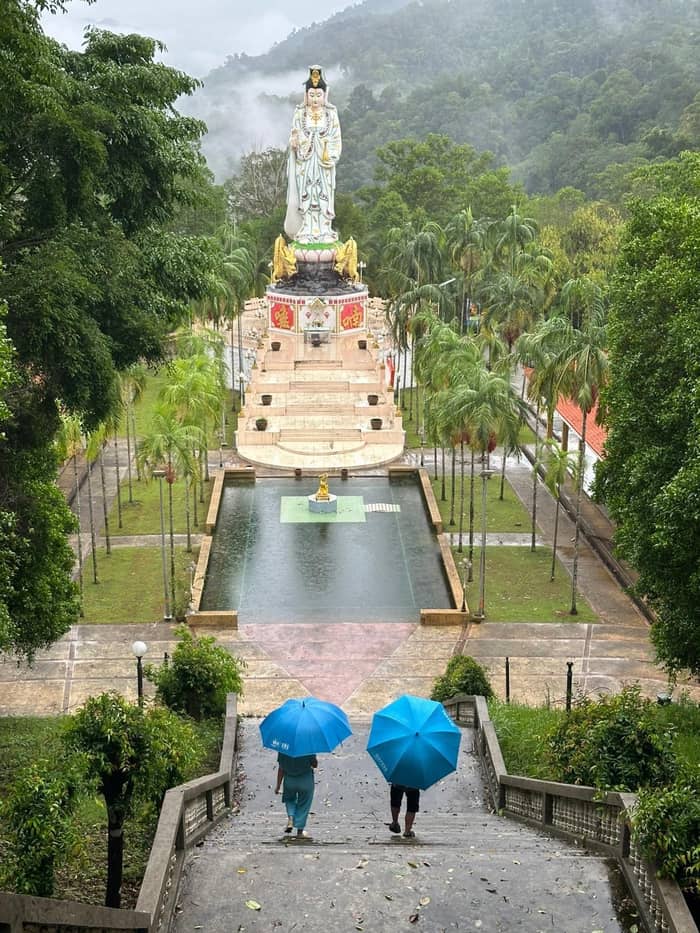
The hall
The lowest cave
Tham Yai
See the temple tourSpot your stop
See 18 route stops
First pick a route, then tap any pin or stop for details and Google Maps.
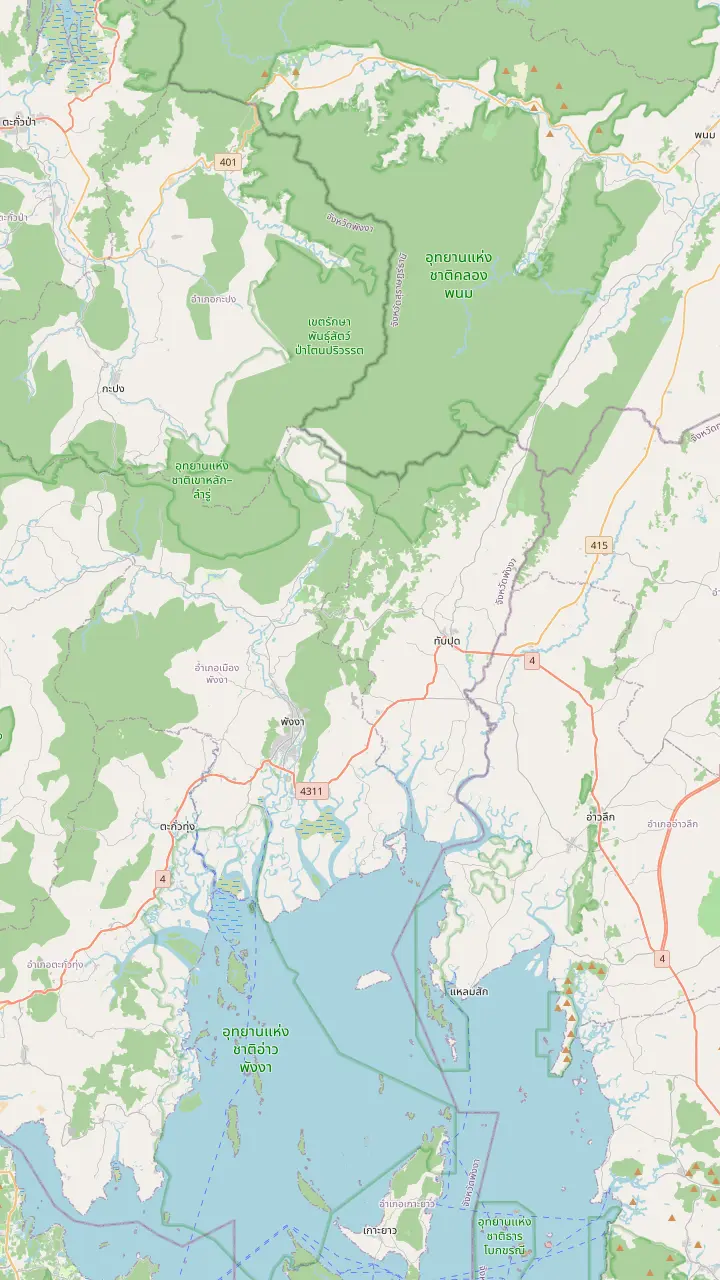
The cave temple lies about 9 km from Phang-nga town on the highway to Phuket.
Google MapsThe provincial town; Takua Pa district lies 66 km from it.
Google MapsThe Dragon Cave Temple, named Tham Phaya Nakarat in one listing, is the first stop of the site's day.
Google MapsWat Rat Uppatham, called Wat Bang Riang, stands on Khao Lan and holds a bell-shaped chedi.
Google Maps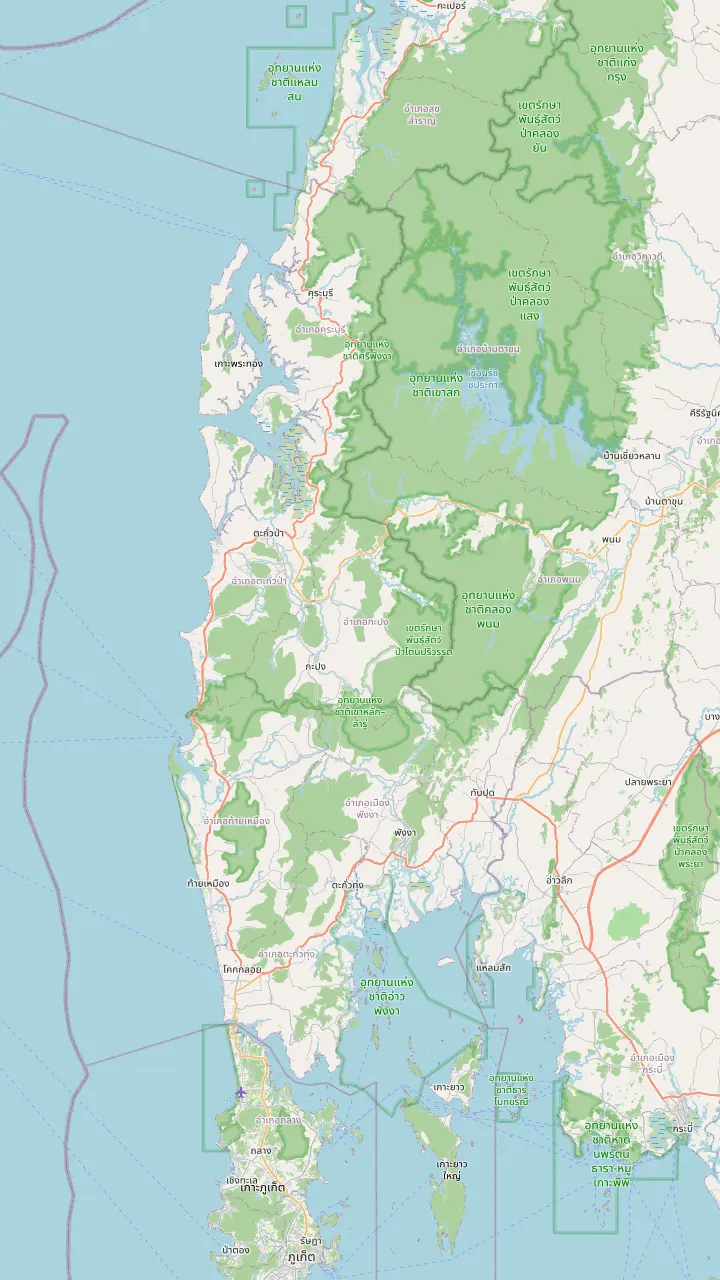
A temple in Khuek Khak that opens the half day of one listing.
Google MapsA Takua Pa temple that two half-day listings include.
Google MapsTalat Yai Takua Pa is the former site of Mueang Takua Pa, an old port town of the Ayutthaya period.
Google MapsWat Rat Uppatham, called Wat Bang Riang, stands on Khao Lan and holds a bell-shaped chedi.
Google MapsThe Dragon Cave Temple, named Tham Phaya Nakarat in one listing, is the first stop of the site's day.
Google MapsWat Rat Uppatham, called Wat Bang Riang, stands on Khao Lan and holds a bell-shaped chedi.
Google MapsThe cave temple lies about 9 km from Phang-nga town on the highway to Phuket.
Google MapsThe provincial town; Takua Pa district lies 66 km from it.
Google Maps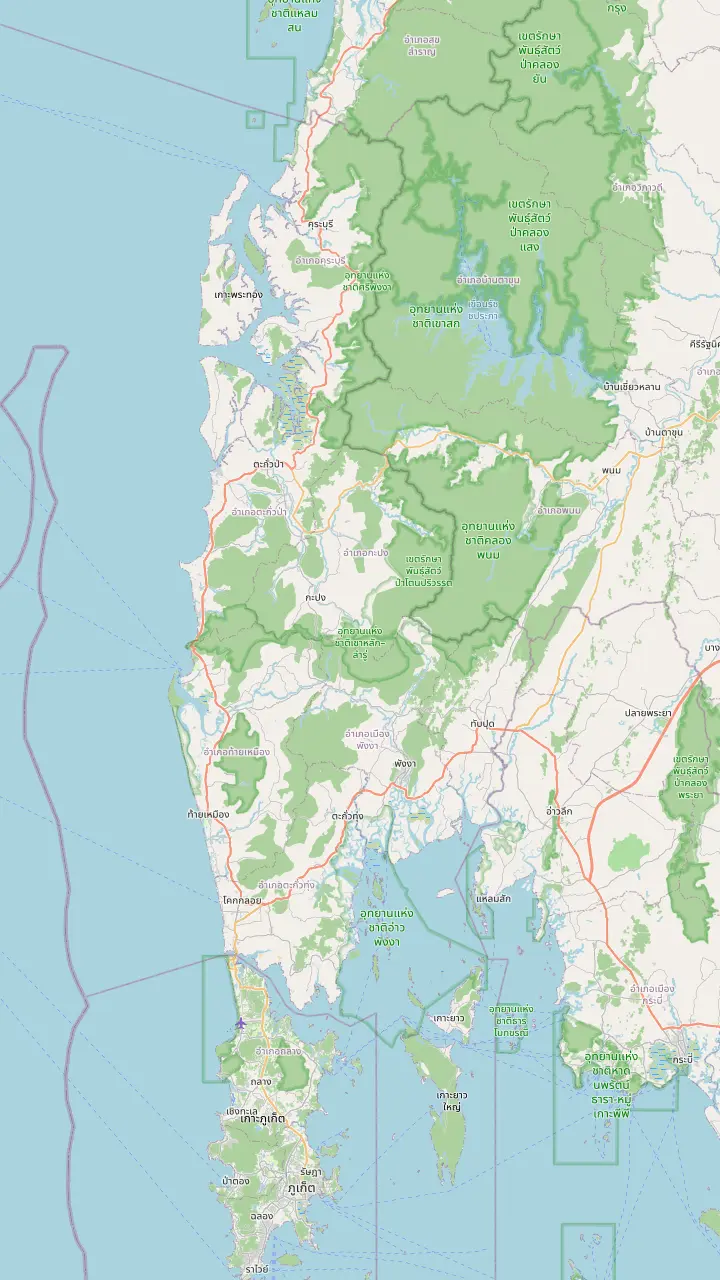
The Khuek Khak area is one of the three pick-up areas of the full-day spiritual temples listing.
Google MapsTalat Yai Takua Pa is the former site of Mueang Takua Pa, an old port town of the Ayutthaya period.
Google MapsThe Dragon Cave Temple, named Tham Phaya Nakarat in one listing, is the first stop of the site's day.
Google MapsWat Rat Uppatham, called Wat Bang Riang, stands on Khao Lan and holds a bell-shaped chedi.
Google MapsThe provincial town; Takua Pa district lies 66 km from it.
Google MapsThe cave temple lies about 9 km from Phang-nga town on the highway to Phuket.
Google Maps© OpenStreetMap contributors, map data
A cave temple on the Phang Nga to Phuket road, with a reclining Buddha in its lowest cave and monkeys on the ground in front. What the official guide says about it, and how to visit well.
Editorial team, khaolaktempletour.click · Updated November 16, 2026 · 7 min of reading
Summary view
Wat Suwan Khuha is the answer when someone asks for the monkey temple near Khao Lak, although it is not close to the beach resorts. The Ministry of Foreign Affairs guide to Phang-nga province places it about 9 km from Phang-nga provincial town on the Phuket highway, with a paved side road of 1 km running to the temple.1 The map above shows where it sits against the other stops.
From Khao Lak the temple is a drive down the main highway and then a short turn off it. A full-day temple listing from Khao Lak visits it as the last stop, after the Dragon Cave Temple, a stop at Bang Rieng and a Thai lunch. A separate listing pairs the temple with an ATV ride and rafting, and gives it a stop of 35 minutes after a van ride of 1 hour. Both figures show how a temple near Khao Lak is usually fitted into a longer day.
Phang-nga town itself is a useful anchor on the map. The guide measures Phuket at 87 km and Krabi at 86 km from the town,5 so the temple sits roughly in the middle of the coast road between the big resort provinces of Phuket and Krabi. If you are driving yourself, set the sat-nav to the temple's name in Latin letters and expect a gate, a small car park and the monkeys before you see any building. It is a temple in Khao Lak's day-trip circuit where the monkeys greet you before the monks do.
The caves
| Cave | What the guide says | Visitors |
|---|---|---|
| Tham Yai | Lowest level, tiled, a wihan3 | The usual first stop |
| Tham Chaeng | Named among the caves2 | Ask your guide |
| Tham Muet | Named among the caves2 | Ask your guide |
| Tham Kaeo | Named among the caves2 | Ask your guide |
| A further cave | Royal initials of kings and family members8 | Look, do not touch |
| Ground in front | Feeding ground of many monkeys4 | Keep food away |
The guide names the caves but does not number them or give opening hours; ask at the temple for what is open on the day.2
In the provincial guide, Wat Suwannakhuha ranks among the province's important temples, with history and archaeology behind it, and the temple climbs a hill that holds several caves.7 It names these: Tham Yai, Tham Chaeng, Tham Muet and Tham Kaeo.2 The names are worth learning, because in Thai they describe the caves: large, bright, dark and crystal. You do not need Thai to feel the difference as you walk from chamber to chamber.
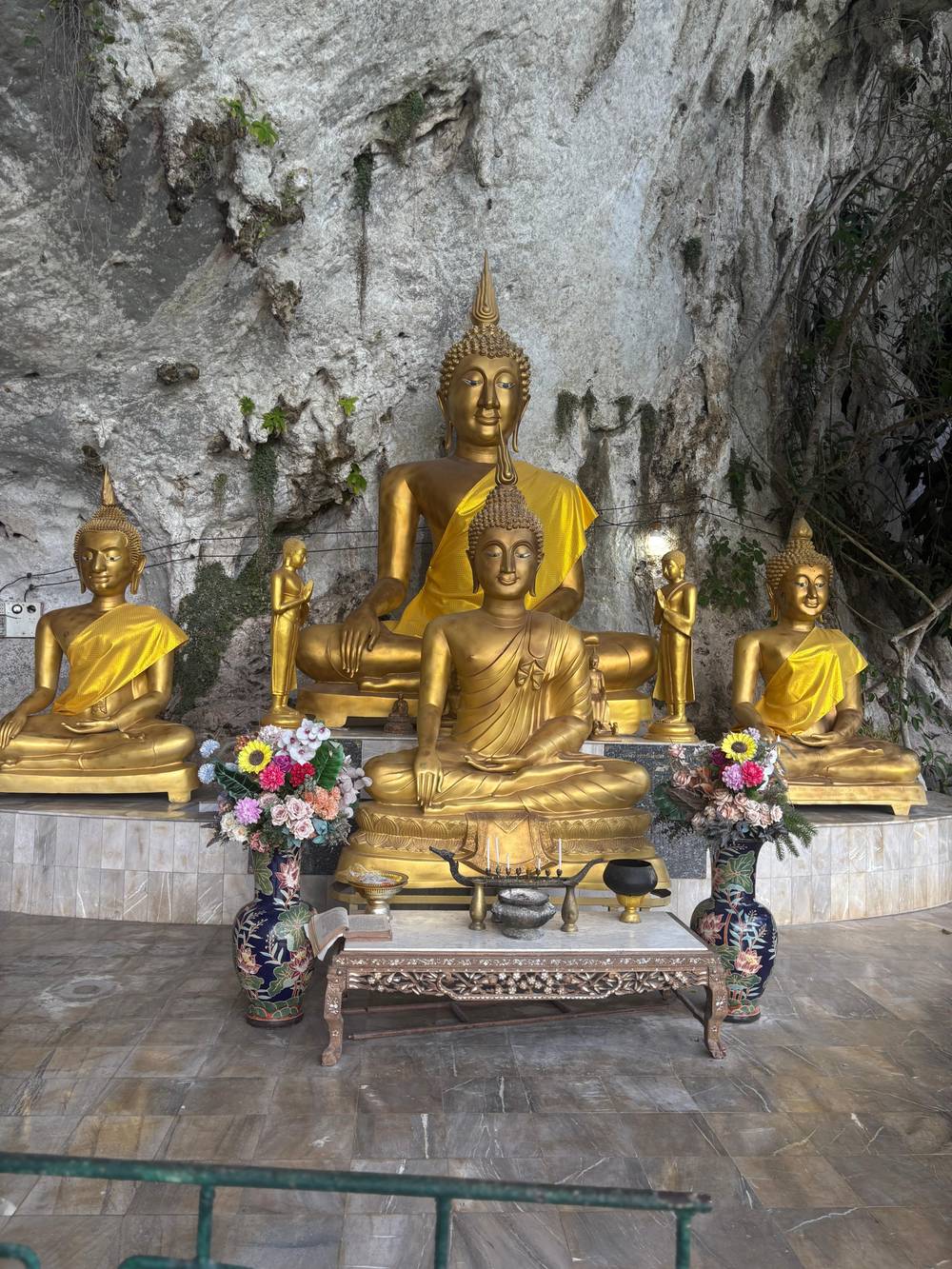
Tham Yai is the cave that visitors usually see first. It is on the lowest level, and the guide says its whole length is covered in ceramic tiles and crockery, and that it works as a wihan, a worship hall, with Buddha images enshrined.3 A wihan is a hall for worship, so this is a working temple space, not a show cave with a ticket office at the mouth. Bring the same manners you would take into any prayer hall.
The guide adds a detail for people who like history: another cave carries the initials of kings and of members of the royal house.8 The same page of the guide lists admission at THB 10 in its 2018 edition,9 so treat that as a guide figure and not a current price. The listings do not say whether entry is covered, so ask your guide on the day rather than counting coins at the gate.
The guide singles out the Reclining Buddha as the most important image among those in Tham Yai.3 A tour listing for the day puts the same figure at 15 meters long, in a giant cave, which is the listing's own measure and not an official measure. Whatever the exact length, the effect is the same: a long, gilded body filling a rock chamber, lit by daylight from the entrance and by lamps further in.
A reclining Buddha is shown lying on one side, head resting on a hand, and the pose is often read as the moment of the Buddha's passing. Thai worshippers treat it with the same reverence as a seated image. Visitors are asked to keep their feet pointing away from a Buddha statue when sitting in front of it and never to touch or point at it.13,14 In a cave with a low ceiling the rule is easy to forget, so look where your feet are before you sit.
Photography is usually allowed, though TAT asks you not to stand in the way of worshippers and people leaving a donation.15 Wait for the person in front of the image to finish, then take your photograph from the side rather than straight down the body. A wide phone lens copes with the cave better than a zoom, and a lens cloth is useful because the air inside can fog glass after the outdoor heat.
Pick your approach
Say what matters most and the answer points to the part of the temple to head for.
If I came for the reclining Buddha
Go straight to Tham Yai
The guide calls the Reclining Buddha the most important image there.3
If I want the cave decoration
Tham Yai again
Its walls are covered in ceramic tiles and crockery along the whole length.3
If I want history
Ask for the royal cave
A cave carries the initials of kings and royals.8
If I have a short stop
Skip the climb
The ATV combination allots 35 minutes, enough for the lowest cave.
If I am nervous of monkeys
Keep to the cave interior
Their feeding ground is in front of the cave.4
Corners of the temple
The hall
Tham Yai
See the temple tour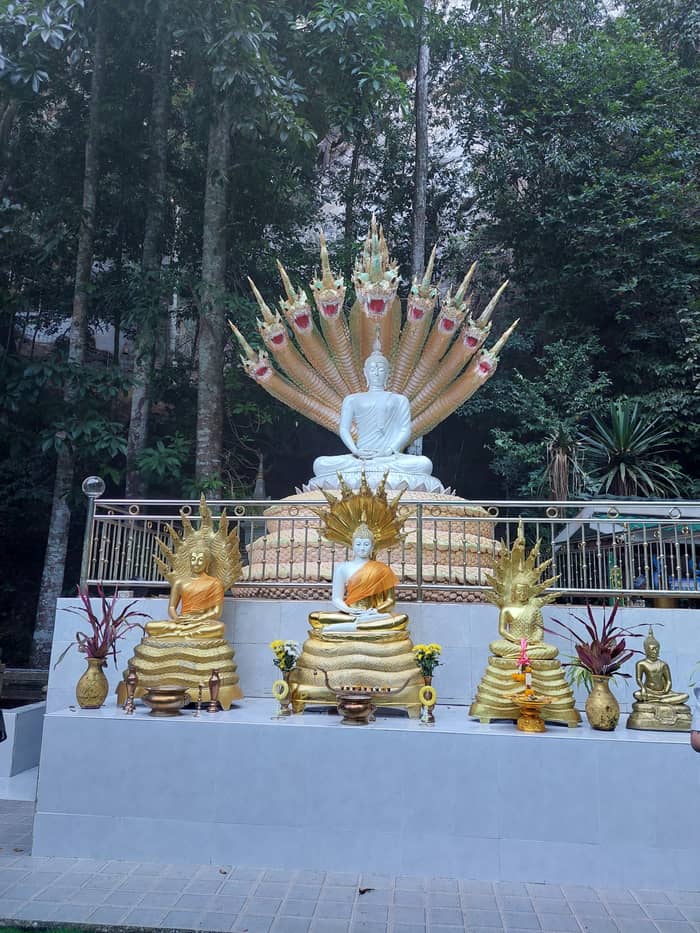
The history
Initials on the rock
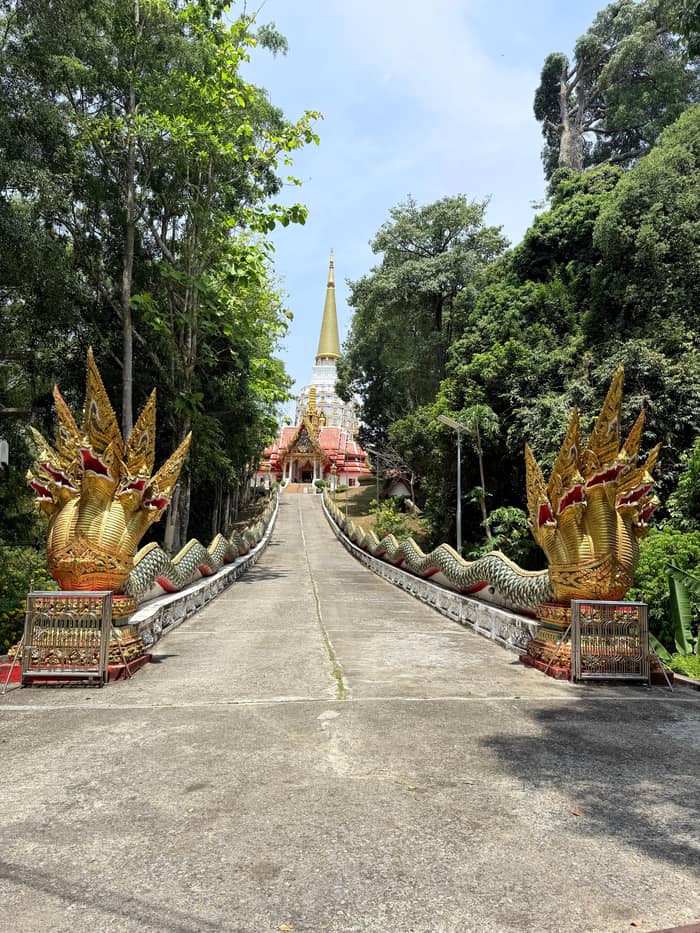
The grounds
In front of the cave
See the temple tourThe monkeys are why the temple has its English nickname. According to the guide, the open space before the cave is a feeding ground for a large number of monkeys.4 These are wild animals living around a monastery, not a petting enclosure, and they know exactly which visitors carry food. Keep snacks in a closed bag, put sunglasses in a pocket and hold your phone with both hands near the steps.
TAT's wildlife guidance, written about elephants but general in its first lines, asks visitors to avoid close interactions and to refrain from feeding wildlife.12 Apply the same rule here even if other visitors are handing out food. A monkey that is fed learns to grab, and the next person to pay for it is someone carrying a drink or a camera strap. If one comes close, stay calm, turn your body away and let your guide or a monk move it on.
Recent reviewers of the day tour mention monkeys at the last temple, a shower during the day and a crowded final stop. That fits what you would expect from a place that is both a pilgrimage site and a stop on many itineraries: it is livelier than the quiet hilltop of Bang Rieng. Go in the early part of the stop if you want the cave to yourself, and leave the food and drink in the vehicle. For a small adventure in Khao Lak that needs no special gear, the monkey ground is the draw.
Same temple, different days
Set the party size and compare what each day that visits the cave temple costs.
Review 2 options
Set the party size and compare what each day that visits the cave temple costs.
≈
View≈
ViewGetYourGuide's starting prices, converted at the ECB reference rate; exact pricing appears when you book.
Walk it in order
Arrival
A paved road of 1 km leads from the highway to the temple.1
The entrance
Entering the hall barefoot is the expectation, with racks outside.6
Lowest level
Tiles and crockery line the cave, which serves as a wihan.3
Inside the hall
The most important of the Buddha images in the cave.3
Higher up
Tham Chaeng, Tham Muet and Tham Kaeo lie on the same hill.2
Outside
Monkeys feed in the open space before the cave.4
Temple etiquette in Thailand is simple once you know it, and TAT states it plainly. TAT's rule is barefoot inside, with racks or spaces for shoes outside,6 and the raised threshold of a doorway should be stepped over and not on.19 In a cave the floor can be damp and uneven, so think about it before you hurry in: tiles stay cool in the morning and can be slick after rain.
Dress follows the same logic as the other stops of the day. A listing for a temple day from Khao Lak bans short sleeves for men and women alike and asks for knee-length shorts at least. The full dress rules, and how to carry a cover-up through a hot day, are on the dress page of this site, so the only point to make here is that a monkey temple is no place to test the limits.
Voices carry in a cave. TAT asks visitors not to speak loudly and not to smoke, chew gum or snack while walking around,20 and to switch the phone to silent.18 The same page asks you to remove hats and sunglasses at temples.18 The last rule is easy to forget when they are also guarding a pair of glasses from monkeys, so take them off in the cave and keep them in a zipped pocket outside.
Video
Chocolate Man With No Plan on YouTube · Video data is requested only when you tap play.
Tham Yai is on the lowest level and decorated with ceramic tiles and crockery throughout its length
Before you go in
A listing that visits the temple as part of a different day gives a clue to timing: the ATV combination allots 35 minutes at the temple, while a James Bond Island day allots 45 minutes to a monastery stop it names Wat Tham Suwan Khuha. Those are the operators' own plans, not a rule of the temple. On the 9 hour temple day the temple comes last, so the time you have depends on how long lunch ran.
If you want to look at the caves above Tham Yai, ask the guide before you start, so that the hour of the day is spent on the part you came for. The day tour tells guests the exact pick-up time after booking and asks guests to come down to the lobby 15 minutes early, which is why the early start is worth honouring: a late departure compresses the cave stop, not the lunch, and a rushed visit is the one that ends with a hurried photograph.
Rain changes this temple more than most. The listing says the programme may be altered if the weather turns, and the UK government names caves among the places where a flash flood after heavy rain is most dangerous.21 Wat Suwan Khuha is a visited, managed site, but an umbrella and a dry bag are sensible, and your driver will know whether the road is open. After a heavy shower the steps and the cave floor stay wet for a while, so slow down.
FAQ
The guide places it off the Phang-nga to Phuket highway, with a paved side road of 1 km leading to the temple.1
The provincial guide calls the space before the cave a feeding ground for many monkeys.4
Tham Yai is decorated with ceramic tiles and crockery and holds several Buddha images, the Reclining Buddha being the most important.3
TAT's wildlife guidance asks visitors to avoid close interactions and to refrain from feeding wildlife.12
TAT's etiquette note expects bare feet inside, with racks or spaces for shoes outside.6
That is the figure in the 2018 provincial guide, so check on arrival, and ask your operator whether entry is covered.9
The listing visits its temples in order, ending with Wat Suwan Khuha.
Sources
Planning the temples from Khao Lak? Ask a real person here.